How does an industrial ultrasonic cleaning tank work? In simple terms, it uses high-frequency sound waves to create millions of microscopic bubbles in a heated cleaning solution, and those bubbles lift grease, carbon, oil and grime off parts without any manual scrubbing. For workshops and manufacturers handling complex components, industrial ultrasonic cleaning is faster, safer and far more consistent than brushing, soaking or pressure washing.
This guide breaks down the technology step by step, so you can understand exactly what happens inside the tank and what to look for before you invest.
How Ultrasonic Cavitation Cleans Industrial Parts
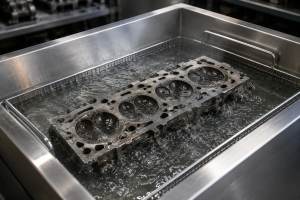
The cleaning action comes from ultrasonic cavitation. Transducers attached to the tank send high-frequency sound waves through the liquid, creating rapid cycles of high and low pressure. During the low-pressure phase, millions of tiny vacuum bubbles form. In the high-pressure phase, those bubbles collapse against the surface of the part, releasing a small burst of energy that knocks contaminants loose. You can read more about this principle in this overview of ultrasonic cleaning and cavitation.
Because the bubbles are microscopic, they reach into blind holes, threads, internal passages and crevices that brushes simply cannot touch. Lower frequencies, commonly around 25 to 40 kHz in industrial systems, produce larger and more aggressive bubbles for heavy soils. Higher frequencies create smaller bubbles that clean more gently, which suits delicate or precision parts.
Key Components of an Industrial Ultrasonic Cleaning Tank
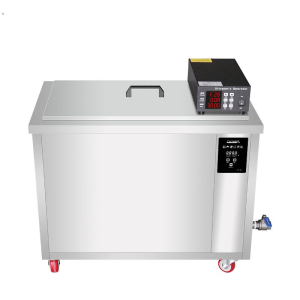
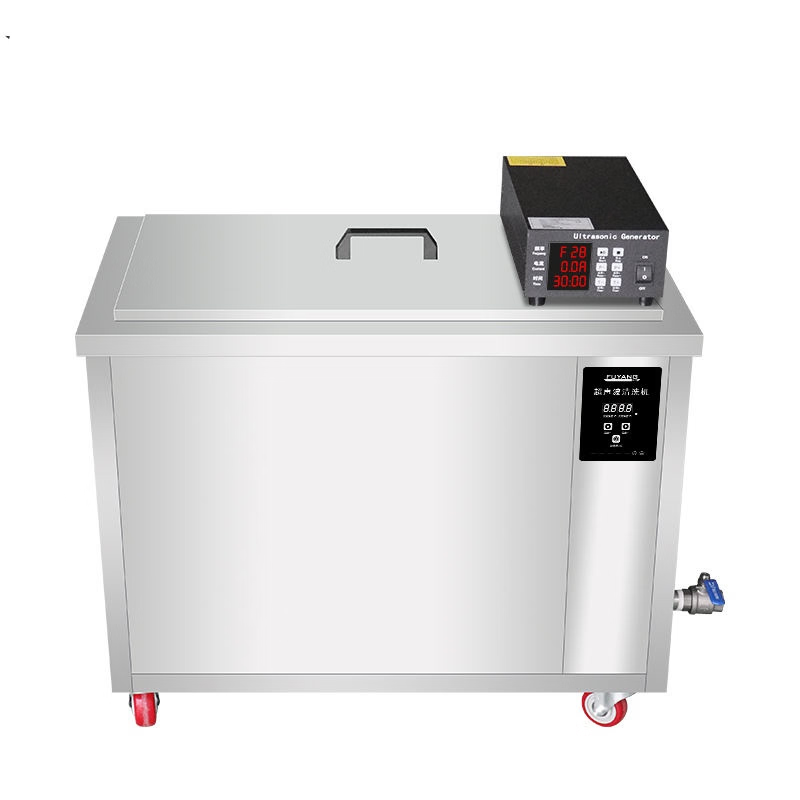
Every industrial ultrasonic cleaning system is built from a few core parts that work together:
- Stainless steel tank: holds the cleaning solution and resists corrosion and constant vibration.
- Ultrasonic transducers: convert electrical energy into the sound waves that create cavitation.
- Ultrasonic generator: supplies and controls the power and frequency sent to the transducers.
- Heating system: warms the solution to speed up grease and oil removal.
- Filtration and pumps: keep the solution clean and circulating, which extends its working life.
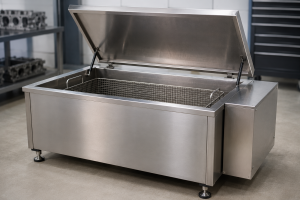
- Baskets and drainage: hold parts safely off the tank base and make draining simple.
The size and power of each element depend on the parts you clean. You can compare these features across our full range of industrial ultrasonic cleaning tanks to see which configuration suits your workload.
The Ultrasonic Cleaning Process Step by Step
The ultrasonic cleaning process follows a simple, repeatable sequence:
- Fill and heat: the tank is filled with water and a suitable cleaning solution, then heated to the working temperature.
- Degas the solution: a short run of the ultrasonics removes trapped air so cavitation works at full strength.
- Load the parts: components are placed in a basket so they are fully submerged and not touching the tank base.
- Run the cycle: the transducers switch on, and cavitation cleans every exposed and hidden surface.
- Rinse: parts are lifted out and rinsed to remove loosened soil and leftover solution.
- Dry and inspect: parts are dried, then checked to confirm they are clean before reassembly or storage.
Cycle time depends on how heavy the contamination is, but the process is consistent from one batch to the next, which is a major advantage for busy production environments.
What Affects Cleaning Performance
Not every tank cleans equally well. Results depend on a handful of variables:
- Frequency: lower frequencies handle heavy soils, while higher ones protect delicate surfaces.
- Power output: higher power gives stronger cavitation across larger tanks.
- Temperature: warmer solutions break down oil, grease and carbon faster.
- Solution chemistry: the cleaning agent should match the contaminant and the part material.
- Loading: overcrowded baskets block the sound waves and leave shadowed areas.
Getting these right is what separates a tank that merely works from one that delivers dependable results every shift.
Where Industrial Ultrasonic Cleaning Is Used
Industrial ultrasonic cleaning is widely used wherever parts have tight tolerances or hidden channels. Common examples include automotive engine components, hydraulic valves and manifolds, aerospace assemblies, marine equipment and mining machinery. In each case, the goal is the same: remove contamination thoroughly without damaging the part.
Conclusion
So, how does an industrial ultrasonic cleaning tank work? Transducers turn electrical energy into sound waves, those waves create ultrasonic cavitation in a heated solution, and the collapsing bubbles remove contamination from every surface, including areas no brush can reach. With the right frequency, power, temperature and tank size, the ultrasonic cleaning process delivers fast, consistent and damage-free results. If you are ready to choose a system for your workshop, explore our range of ultrasonic cleaning tanks and find the one that fits your parts and production needs.