Picking the right ultrasonic cleaning tank isn’t just about going bigger it’s about matching the machine to your parts, your throughput, and your workshop layout. Get it wrong, and you either waste money on unused capacity or end up with a tank too small to handle your daily workload. This guide walks you through exactly how to choose an ultrasonic cleaning tank that fits your business, whether you’re running a small automotive workshop or a large-scale manufacturing plant.
Why Ultrasonic Tank Size Actually Matters
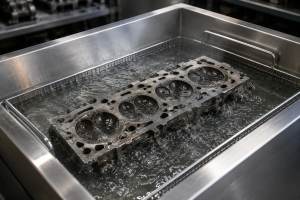
Every ultrasonic cleaning tank uses high-frequency sound waves to create microscopic bubbles that implode against a part’s surface, lifting away grease, carbon, and contaminants without scrubbing or harsh chemicals. This process, known as cavitation, only works properly if the tank is sized correctly. A tank that’s too small won’t fully submerge larger components, leaving dirty spots untouched. A tank that’s too large for your typical part size wastes water, chemical solution, energy, and heating time on every single cycle.
That’s why understanding ultrasonic tank size options from compact desktop units to multi-thousand-litre industrial systems is the first step before you invest.
Match the Tank to Your Application
Different industries need different Ultrasonic Cleaning Tank dimensions and power outputs. Here’s a general breakdown:
- Laboratory & precision work (5L–20L): Ideal for small components, jewellery, lab equipment, and delicate parts that need gentle, controlled cleaning at lower temperatures.
- Automotive workshops (80L–230L): Suited for fuel injectors, carburettors, inlet manifolds, EGR systems, DPFs, and hot pipes. These mid-range tanks are compact enough for a workshop floor but powerful enough for daily use.
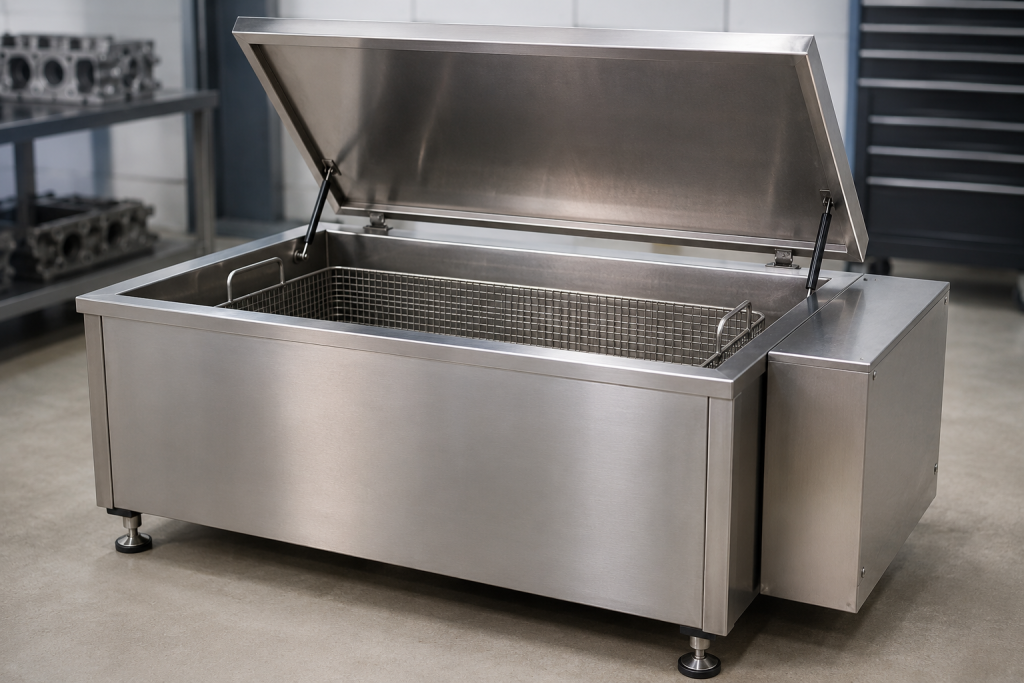
- Heavy industrial & manufacturing (400L–850L): Built for engine blocks, transmission housings, hydraulic components, and continuous high-throughput cleaning on a production line.
- Aerospace, defence & marine (1500L–5000L+): Designed for large assemblies, mining equipment, and shipyard components where consistency and heavy-duty performance are non-negotiable.
Thinking about industrial cleaning tank capacity in these terms makes it much easier to shortlist the right range before you even look at specific models. You can browse our full range of industrial ultrasonic cleaning tanks to compare sizes and specifications side by side.
Key Factors to Consider Beyond Litres
Tank volume is important, but it’s not the only factor. Before deciding, think about:
- Part dimensions – Measure your largest components, including how they’ll sit inside the tank (some parts need to be positioned sideways to fit).
- Frequency – Lower frequencies (like 40kHz) suit delicate parts, while different frequency ranges work better for heavier soil removal.
- Heating capability – Some tanks reach up to 90°C, which matters for breaking down oils, grease, and carbon buildup.
- Material build – Stainless steel inner tanks (like 316-grade) resist corrosion and hold up under continuous industrial use.
- Power supply – Single-phase units suit smaller workshops, while 3-phase systems support higher heating output and features like integrated pumps and filtration.
- Throughput needs – If you’re running multiple cleaning cycles a day, factor in how quickly the tank heats, cleans, and drains between batches.
When a Standard Tank Isn’t Enough
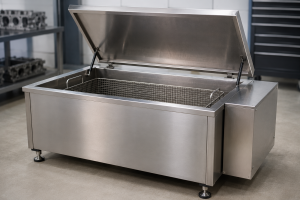
Sometimes your parts, your facility, or your production volume don’t fit neatly into a standard size. This is where custom Ultrasonic Cleaning Tank come in. A custom-built tank can be tailored to your exact part dimensions, power requirements, mounting setup (like heavy-duty castors for mobility), and filtration needs so you’re not compromising on either performance or floor space. Businesses in aerospace, defence, and large-scale infrastructure maintenance especially benefit from custom configurations, since off-the-shelf sizes rarely match the scale of their components.
Making the Final Decision
Start by listing your most commonly cleaned parts and their maximum dimensions. Then estimate your daily or weekly cleaning volume. From there, match your needs against standard tank ranges and if nothing fits perfectly, a custom solution will almost always cost less in the long run than working around an ill-fitting machine.
Conclusion
Choosing the right tank size comes down to knowing your parts, your industry, and your daily output not just picking the biggest option available. Whether you need a compact laboratory unit or a heavy-duty industrial system, understanding how to choose an ultrasonic cleaning tank properly will save you money, time, and frustration down the line. If your requirements don’t match a standard size, don’t force it explore a custom-built option designed around your exact specifications, or check out our complete range of tanks to find the closest match to your needs.